
How Govini Became Air and Enterprise Readiness Was Born
The film moved quickly through four scenes from across the defense enterprise.
A Navy engineer tracking a program that had slipped for years.
An Army officer waiting on a supplier.
A Marine chasing paperwork for a part that had already been approved.
An Air Force maintainer holding a fleet together with a spreadsheet of hard-to-find components.
Each person was doing extraordinary work inside a system that depended on them to overcome its limitations by hand.
The screen went dark and left the audience at Re:industrialize with a question:
Are we ready?
When Tara Murphy Dougherty walked onto the stage, she made clear that the question was not rhetorical.
Frontline decisions happen in seconds. The enterprise responsible for supporting them moves in years.
A few days of combat operations recently consumed nearly two years of THAAD interceptor missile deliveries, while replacing them would take thirty months. Programs that once reached initial operating capability in roughly six years are now taking nearly twelve. Nearly three out of four Air Force aircraft entering depot maintenance are coming out late.
The United States is spending approximately $700 million every day on defense readiness, and seeing diminishing readiness in return.
Tara gave the distance between those two realities a name: the Readiness Gap.
Then she introduced the solution and a new category created to close it: Enterprise Readiness.
A few minutes later, Govini became Air.
From the audience, it looked like one carefully orchestrated launch: a newly named problem, a new category, a clear platform architecture, live demonstrations, a partnership announcement, and a full company rebrand.
The launch was the public expression of a belief that the company's leadership had spent months developing, testing, sharpening, and ultimately committing to.
That belief began with the recognition that the market’s understanding of the company had become too narrow.
The Frame That No Longer Fit
As Govini, the company had established a strong position in defense acquisition software. Its platform helped government leaders understand suppliers, industrial capacity, spending, program performance, and supply-chain risk with a depth and speed that traditional systems could not match.
The frame was credible because it reflected real work and real customer value.
It had also become a constraint.
The company’s capabilities and customer engagements increasingly reached beyond acquisition. A supplier-risk problem could determine whether production stayed on schedule. A production limitation could become a sustainment failure. A maintenance delay could reduce the assets available for an operational mission. Decisions made in one part of the lifecycle created consequences elsewhere, often years later and several organizations removed.
The existing frame separated these problems into familiar markets: acquisition, supply chain, logistics, sustainment, industrial-base analysis. The company's experience suggested they were connected manifestations of a more systemic failure.
That created the central strategic question:
Were we helping customers improve acquisition, or was it something far bigger and interconnected?
This is the moment readiness redefined the scale of the opportunity.
Acquisition describes a function. Readiness describes the condition the entire system exists to achieve.
As leadership embraced that distinction, it became difficult to return to the old frame. The company could continue presenting itself as a better solution within an established software market, or it could define the larger problem its work had revealed and build the category required to solve it.
Category creation becomes real with that kind of belief. Before a company can teach a market to see something new, its own leaders must have conviction that the old explanation is no longer sufficient.
Building Belief Inside the Company
The first task wasn’t finding a new category name. It was developing a shared point of view strong enough to guide the company.
Through executive interviews, customer evidence, deep working sessions, and repeated debate, we began assembling the full argument with the leadership team.
The frontline operates at the pace of the mission. The enterprise behind it operates through a quagmire of suppliers, primes, agencies, commands, disconnected systems, manual processes, and institutional boundaries. No single actor owns readiness, yet readiness depends on all of them executing together.
The people inside that system were not the enemy. Their ingenuity and persistence were often the only reasons it continued to function.
The architecture around them was the problem.
That insight moved the story beyond the familiar claim that defense processes are slow. Slowness was an outcome. The deeper failure was the enterprise’s inability to continuously coordinate the people, data, resources, and decisions required to develop, produce, deliver, and sustain capability.
The leadership team named that failure the Readiness Gap: the dangerous distance between what the frontline needs and what the defense enterprise can deliver.
The next belief followed directly from the problem.
Readiness could no longer be treated primarily as a report, rating, milestone, or periodic assessment. It had to be understood as the live state of the force and everything supporting it at the moment the mission demanded action.
Ready is a real-time condition that must be continuously achieved.
That statement became the conceptual center of the work. It redefined the outcome, expanded the scope of the platform, and created urgency for a new category.
Before Naming and Claiming, Condition the Market
A company cannot introduce a category effectively if the market has not first learned to recognize the problem.
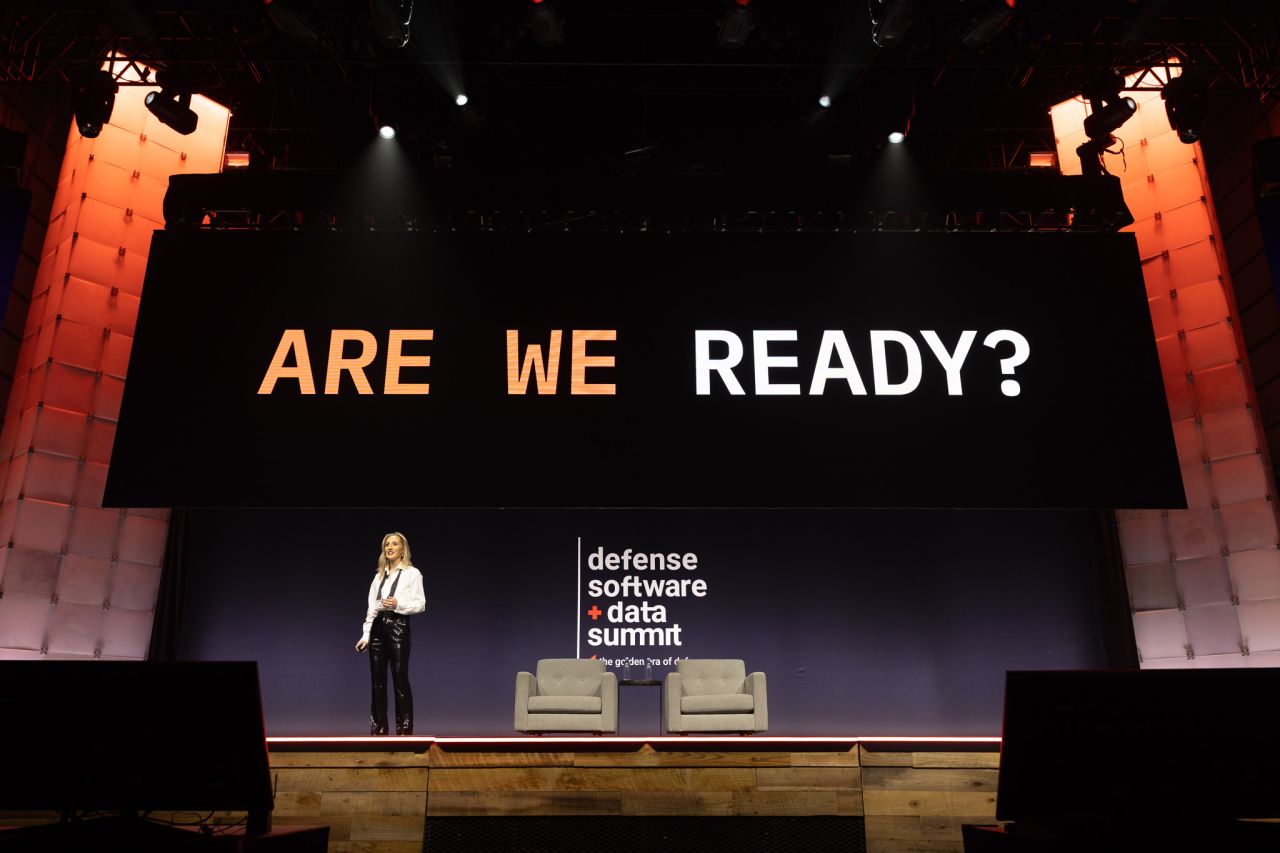
Months before Re:industrialize, Tara used the company’s Defense Software + Data Summit to begin that process. Her opening remarks exposed the widening asymmetry between the pace of operational demand and the pace of institutional response. She connected familiar symptoms - production delays, fragile supply chains, maintenance shortfalls, aging systems, and slow acquisition - to a larger structural reality.
The solution, the category itself was not yet part of the message. The objective was to make the audience feel the inadequacy of the existing explanation.
This is one of the most important and frequently overlooked parts of category creation. Naming a new solution before people understand the problem usually produces confusion or worse, indifference. The market first needs a new lens through which its current frustrations become connected and consequential.
The Summit opening created that lens.
In the months that followed, the team continued refining the problem, quantifying its cost, developing the new definition of readiness, and expanding the story to cover the full defense lifecycle. The question posed at Summit became the problem named and the solution defined at Re:industrialize three months later.
Making Belief Tangible
A category cannot remain conceptual. It needs an architecture that shows customers what is required to solve the problem and gives the company a north star to build toward.
For Enterprise Readiness, that architecture is the category blueprint.
It starts with the activation of data across the defense enterprise to create a continuously updated and authoritative view of readiness. It then orchestrates intelligence, AI, and workflows that translate into action through the execution layer, organized around a full defense lifecycle where readiness is continuously created - from develop and produce to deliver and sustain.
The blueprint did more than describe the platform. It translated the company’s new belief into an operating model. It also gave product, sales, marketing, and leadership a common architecture around which to align decisions.
This was where the transformation moved beyond a narrative.
The category began shaping product direction, packaging, customer narratives, sales materials, market education, and the company’s view of its future. Enterprise Readiness was becoming the organizing principle for the business.
Why Govini Had to Become Air
The name Govini carried credibility and years of hard-earned recognition. Changing it created significant execution risk, particularly under a compressed timeline leading into Re:industrialize.
The strategic decision itself was clearer.
Govini represented the company’s origins and the market frame it was moving beyond. The leadership team was making a larger claim about the problem, the platform, and the role the company intended to play across the defense enterprise. The identity had to support that ambition.
The name Air captured the idea of something essential moving continuously across boundaries. Readiness must move among suppliers, primes, agencies, operators, systems, and missions. When that coordination works, it becomes part of the environment in which the enterprise operates.
The challenge was not deciding whether the company had changed. It was executing every consequence of that decision at once.
The company needed a new identity, website, messaging, product story, sales materials, internal mobilization effort, customer communications, and market activation plan. The rebrand could not sit alongside the category strategy as a separate workstream. Every element had to reinforce the same shift.
By launch day, the company’s problem, category, platform, blueprint, and name had become parts of one coherent story.
When Belief Goes Public
That story returned to where the keynote began: the people holding readiness together through manual effort.
Tara showed the audience what Enterprise Readiness looked like when the architecture began carrying work that individuals had previously carried themselves.
A weapon leaving an aircraft became an immediate demand signal to the enterprise. Cannibalized aircraft parts became actionable information rather than lost activity. The expenditure of a munition triggered replenishment analysis before anyone had filed a report.
She also shared evidence from active programs: hundreds of equipment down-days avoided in the Pacific; a Navy maintenance decision compressed from a twelve-person, twelve-hour process to one analyst working for five minutes; supply-base questions answered with a depth the existing system had failed to produce.
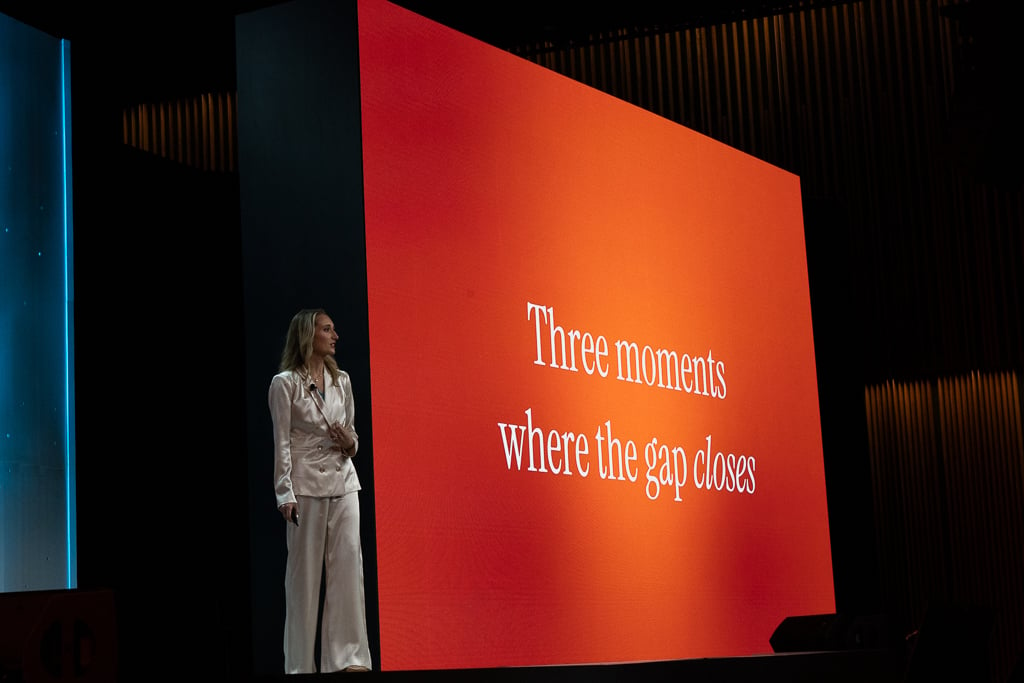
These examples mattered because the category was not presented as a distant prediction. Air had been building toward it inside real programs for years. The launch gave that work a common name, architecture, and ambition.
That is the distinction between inventing language and revealing a category already emerging through customer need and product reality.
When Belief Becomes Shared
Re:industrialize marked the completion of the first phase of transformation.
Air publicly named the problem, defined Enterprise Readiness, introduced the blueprint, demonstrated the platform, and aligned the company’s identity with the category it will lead.
Now the real adventure begins.
A category becomes real when the belief spreads beyond the people who created it. Employees use it to make decisions. Customers use it to explain their needs. Product teams use it to determine what to build. Sales teams use it to expand the conversation. Partners, policymakers, analysts, and eventually competitors begin adopting its language and assumptions.
Air has made the initial case: the defense enterprise does not suffer from a series of isolated functional failures. It faces a Readiness Gap created by an architecture unable to coordinate execution at mission speed. Enterprise Readiness is the system required to close it.
The next phase is proving that belief repeatedly through product delivery, customer outcomes, and market adoption.
Govini became Air on June 16. The more consequential change had already happened, when the company decided it could no longer explain its work through a frame it had outgrown and chose to build belief in something larger.
This is how categories are made. Not claimed from a stage, but believed into being long before the market is able to clearly see them.